
The Equine Digital Cushion: Hoof Function, Shock Absorption and Biomechanics
A semi-scientific review for farriers, veterinarians and equine professionalsHoof Function Begins with the Landing
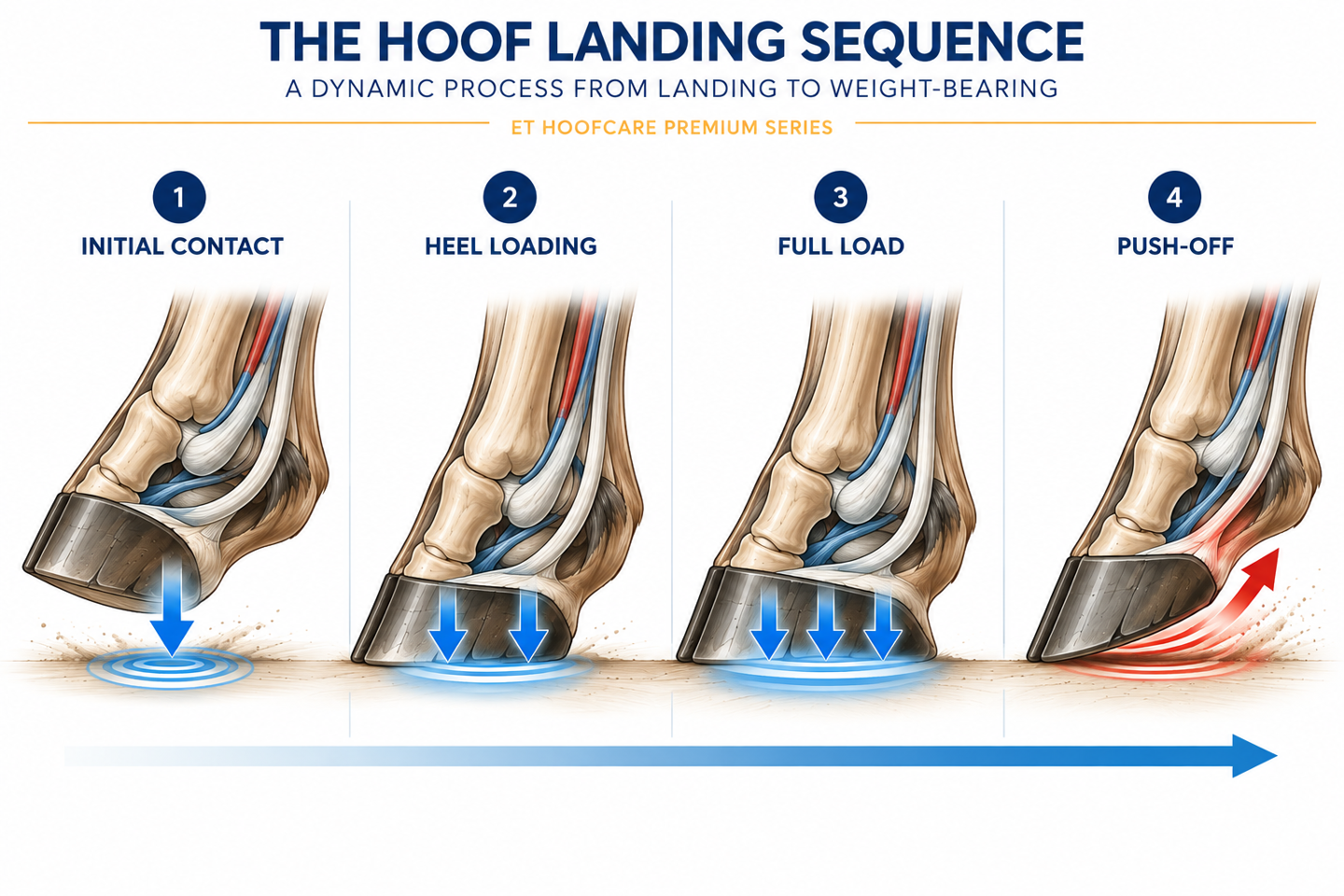
Every stride begins when the hoof meets the ground. Within a fraction of a second, substantial mechanical forces are generated and must be absorbed, distributed and controlled before they are transmitted further into the limb.
The way a horse lands therefore has a direct influence on the mechanical behaviour of the entire hoof and, consequently, on the structures of the distal limb.
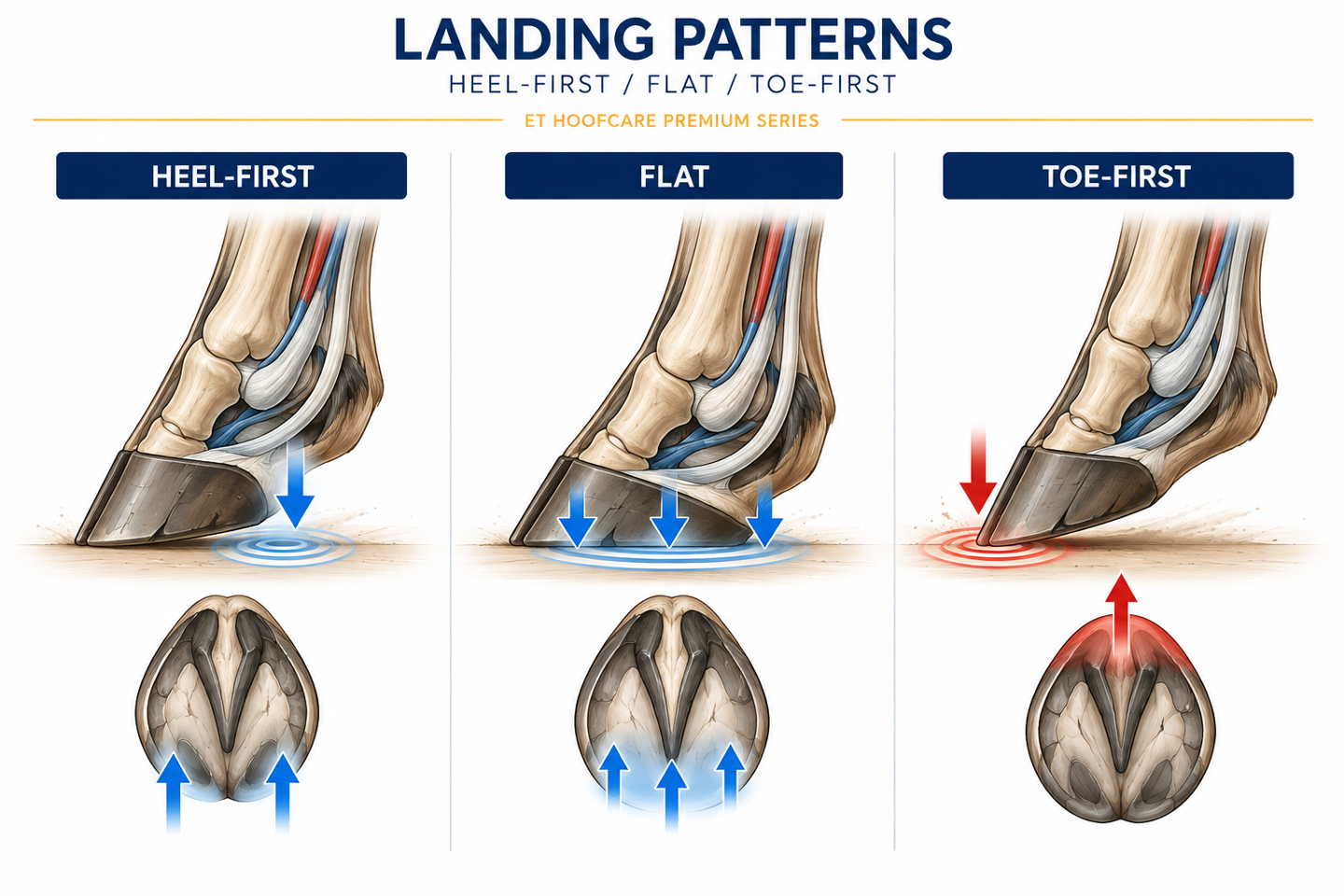
In a healthy horse moving comfortably, the hoof generally lands slightly heel-first or, depending on speed and footing, almost flat. This allows the caudal hoof to engage immediately and enables the digital cushion, frog and lateral cartilages to perform their natural biomechanical functions.
A consistently toe-first landing creates a different loading pattern. The caudal hoof receives less mechanical stimulation, while greater forces may be transmitted towards structures such as the deep digital flexor tendon (DDFT), the navicular apparatus and the distal joints.
For both veterinarians and farriers, observing the landing pattern is therefore an important part of a functional equine hoof assessment . However, the landing pattern should always be interpreted in the clinical context of the individual horse rather than considered in isolation.
The Hoof's Shock Absorption System
Although the digital cushion is often described as the hoof's primary shock absorber, it does not work independently.
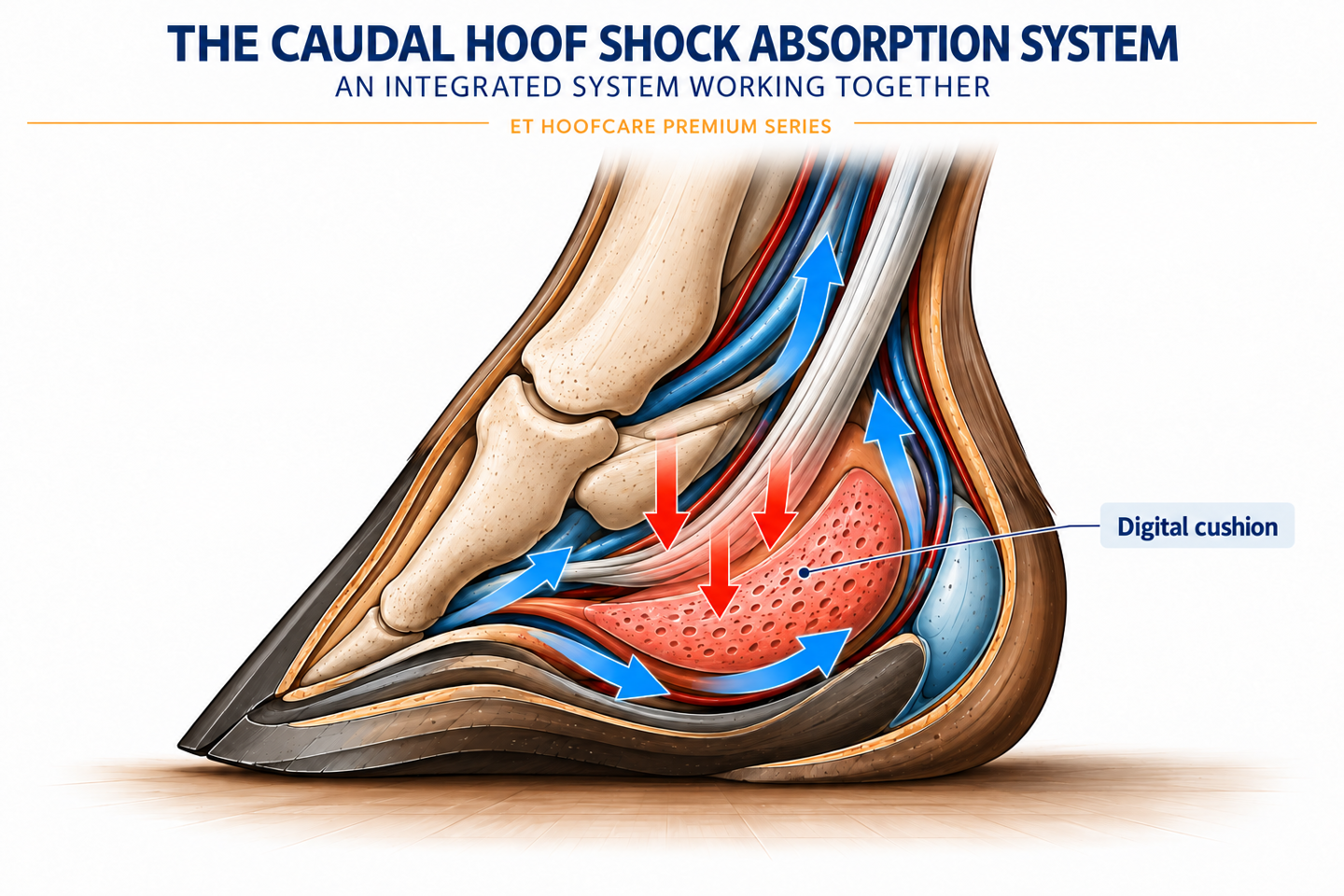
The frog, digital cushion, lateral cartilages and hoof capsule form an integrated biomechanical system. Together, these structures absorb impact, redistribute mechanical forces and help control how loading is transmitted through the limb.
How the Caudal Hoof Responds to Impact
When the hoof contacts the ground, the heels and frog engage with the surface. The frog begins to deform, while the digital cushion is progressively compressed. At the same time, the lateral cartilages undergo a small degree of outward movement and the hoof capsule can widen measurably.
These movements allow impact forces to be distributed through several structures rather than concentrated at a single point.
The resulting sequence occurs extremely rapidly, within milliseconds, and is repeated thousands of times during everyday locomotion.
The system can be compared, in broad engineering terms, with a sophisticated suspension mechanism in which different components work together to absorb shock while maintaining stability.
The important point is that the hoof does not rely on one anatomical structure to perform this function. Hoof shock absorption is the result of coordinated movement throughout the caudal hoof.
The Frog: More Than a Horn Structure
The frog is often described simply as the triangular horn structure located on the solar surface of the hoof. Its role, however, extends well beyond its external appearance.
Because the frog increases the ground-contact area and transfers mechanical forces towards the deeper structures of the caudal hoof, it contributes directly to hoof stability and shock absorption.
Its relationship with the digital cushion is particularly important. When the frog engages with the ground, mechanical forces can be transmitted into the underlying digital cushion, allowing the two structures to function together.
The frog also contributes to the hoof's circulatory mechanism and can provide additional traction depending on the surface.
This relationship explains why frog health is not merely a cosmetic consideration. A weak, atrophied or chronically compromised frog can alter the mechanical behaviour of the caudal hoof and reduce the efficiency with which forces are managed.
At the same time, frog condition must always be interpreted alongside hoof balance, heel conformation, loading and the horse's overall movement pattern.
The Lateral Cartilages: Flexible Reinforcement of the Hoof
On either side of the digital cushion are the lateral cartilages , also known as ungual cartilages. These substantial cartilaginous structures extend upwards from the wings of the coffin bone and are closely associated with the digital cushion.
Their position allows them to contribute to the structural support and flexibility of the heel region.
During weight-bearing, the lateral cartilages can move slightly outward as the digital cushion is compressed. As the hoof leaves the ground, they return towards their resting position.
Although these movements occur on a relatively small scale, they form an important part of the overall hoof mechanism.
The lateral cartilages contribute to force distribution, heel support and shock absorption while also participating in the mechanical environment associated with venous blood return.
Their function illustrates a fundamental principle of equine hoof biomechanics: relatively small movements at the level of individual structures can have significant consequences when repeated over millions of loading cycles.
The Digital Cushion and the Hoof's Circulatory Mechanism
One of the most fascinating functions associated with the digital cushion is its relationship with blood circulation.
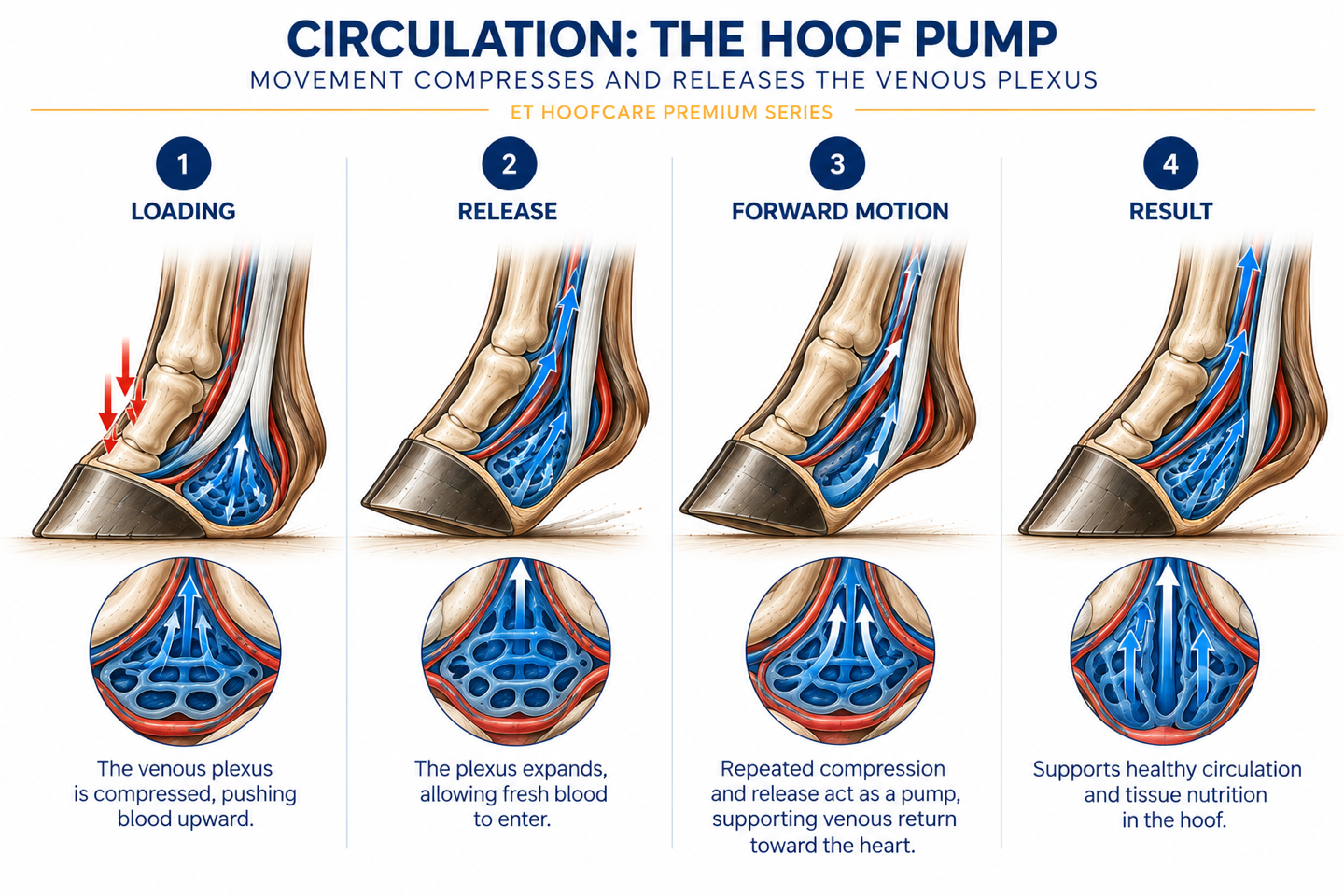
The equine hoof contains an extensive network of arteries, veins and capillaries. Because the hoof contains comparatively little muscle tissue capable of actively assisting venous return, mechanical movement within the hoof contributes to the circulation of blood.
During weight-bearing, compression of the digital cushion contributes to changes in pressure within the hoof and helps displace venous blood. When the hoof unloads during breakover and the swing phase, the tissues re-expand and internal pressure changes again.
Each stride therefore contributes to a cyclical mechanical process that supports blood movement through the foot.
This is one reason why movement is essential for hoof health. Regular movement repeatedly activates the structures involved in the hoof mechanism, whereas prolonged periods of immobility reduce this mechanical stimulation.
The hoof is therefore not simply a passive structure protecting the distal limb. It is a dynamic biological system whose mechanical function is closely connected with circulation.
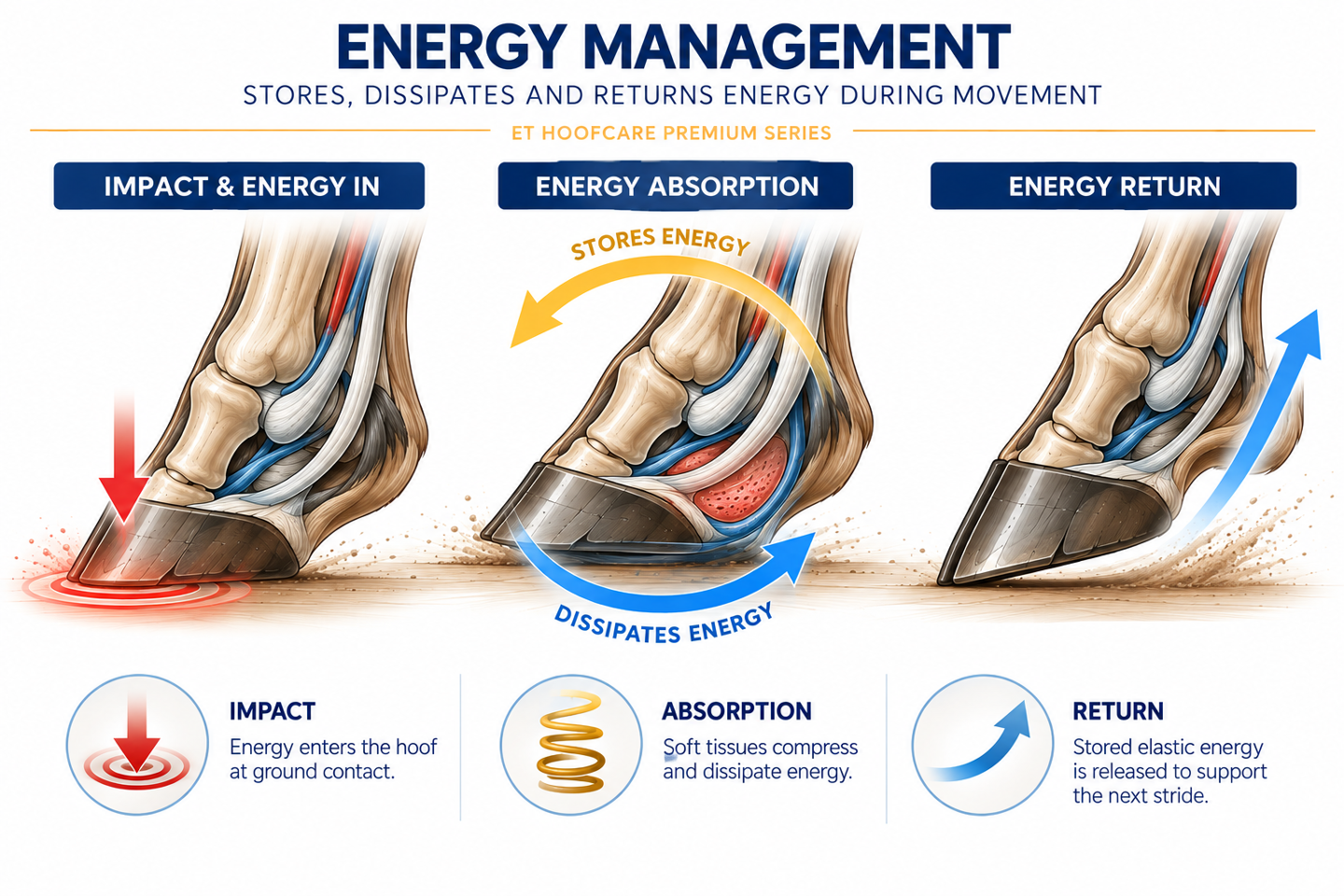
The Digital Cushion as an Energy Management System
Shock absorption is only part of the story.
Because the digital cushion is viscoelastic, it can temporarily store a portion of the mechanical energy generated during loading. Some of this energy can subsequently be released as the hoof unloads and moves through the stride.
This means that the digital cushion behaves not only as a damping structure but also as an element of elastic energy storage and return.
The ability to absorb some energy while retaining and returning part of it contributes to efficient locomotion. It helps the horse manage the mechanical demands of movement without simply dissipating all incoming energy as heat or deformation.
In practical terms, this contributes to smoother movement and efficient stride mechanics.
The digital cushion should therefore be understood as part of an energy-management system rather than simply as a biological shock-absorbing pad.
Protecting the Navicular Apparatus
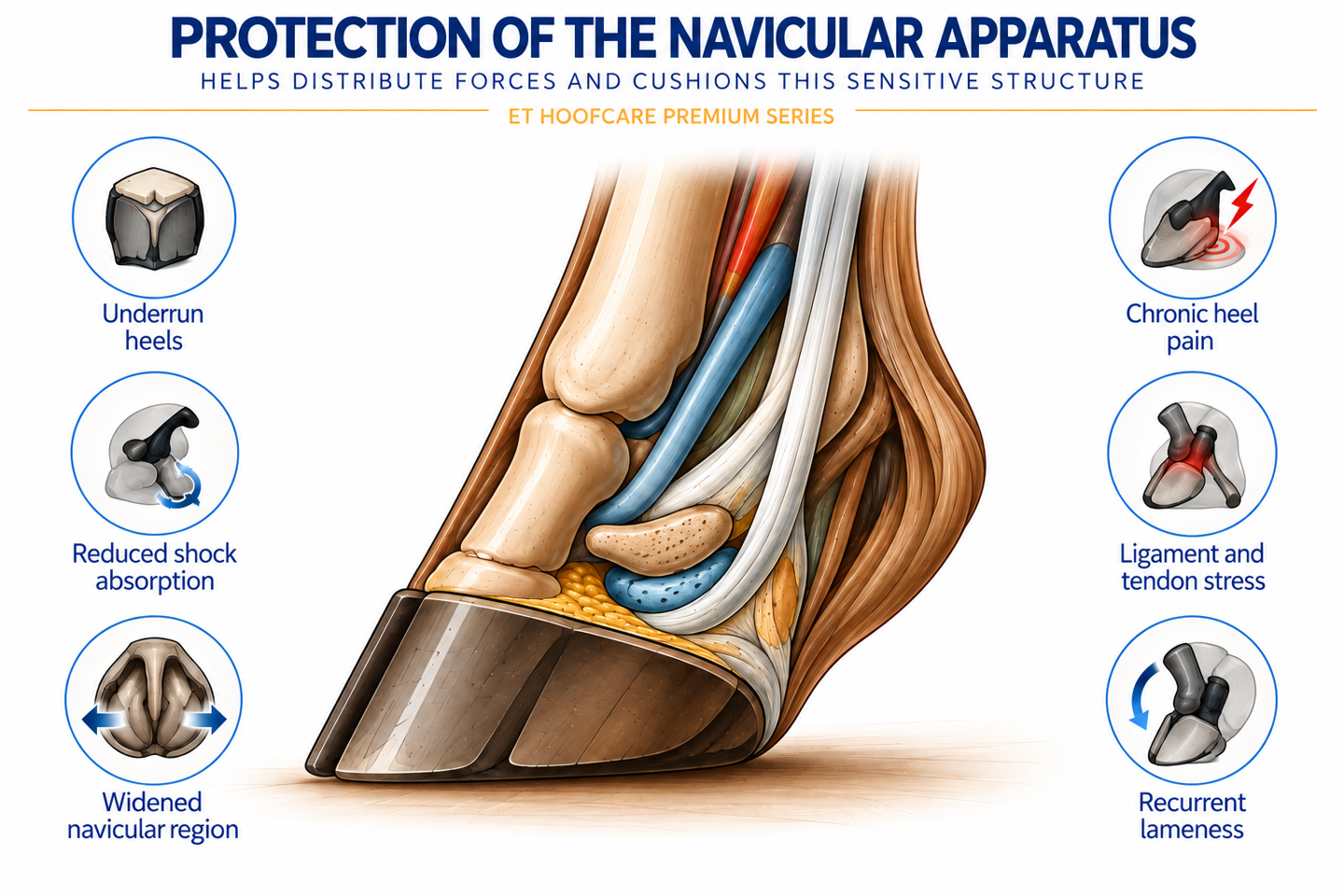
The anatomical position of the digital cushion places it in close relationship with several structures of the navicular region.
These include the navicular bone, deep digital flexor tendon, navicular bursa, impar ligament and palmar aspect of the coffin bone.
Because these structures are closely interconnected, the digital cushion contributes to the distribution of mechanical forces within the caudal hoof.
Rather than allowing forces to become concentrated in a small area, deformation of the digital cushion helps distribute loading over a broader region.
This is particularly relevant to the mechanical environment surrounding the navicular apparatus.
When the digital cushion is poorly developed or has undergone degenerative changes, force distribution may become less efficient. As a result, mechanical stress on structures such as the deep digital flexor tendon and navicular bone may increase.
It is essential, however, to avoid interpreting this relationship as a direct causal link between digital cushion degeneration and navicular disease.
Navicular-region pain and pathology are multifactorial. Hoof balance, conformation, workload, footing, genetics and individual biomechanics can all contribute to the clinical picture.
The digital cushion should therefore be regarded as one component of a much larger biomechanical system.
Why Heel-First Landing Matters
Few subjects have generated as much discussion in modern hoof biomechanics as the importance of heel-first landing.
In a physiologically functioning hoof, the heels generally contact the ground slightly before the toe. This allows the caudal hoof to become involved early in the loading cycle.
Heel-first loading can stimulate engagement of the frog, compression of the digital cushion and movement of the lateral cartilages. It also provides mechanical stimulation to the tissues of the caudal hoof and contributes to the hoof's circulatory mechanism.
Repeated physiological loading may therefore contribute to the long-term development and maintenance of a strong, resilient digital cushion.
However, the concept should not be oversimplified.
A horse should not be forced into a heel-first landing without understanding why it is landing differently. A toe-first landing may reflect pain or altered biomechanics, and attempting to manipulate the landing pattern without addressing the underlying cause may be counterproductive.
The objective of hoof care should be to restore functional biomechanics, not to impose a particular landing pattern regardless of the individual horse.
Flat Landing: A Normal Variation
Not every sound horse lands distinctly heel-first.
Depending on speed, footing, conformation and individual movement characteristics, many horses land almost flat. This can represent a normal variation when the caudal hoof is still receiving appropriate mechanical loading and the horse is moving comfortably.
For this reason, landing pattern should be assessed dynamically rather than judged from a single frame or a fixed anatomical ideal.
The important question is not simply whether the heels touch the ground first, but whether the hoof is functioning efficiently and comfortably within the context of the individual horse.
Toe-First Landing: When It Becomes Clinically Significant
Persistent toe-first landing is generally considered a sign that warrants investigation, particularly when accompanied by altered movement or evidence of discomfort.
Several factors may contribute to a toe-first landing, including heel pain, underrun heels, long toes, poor hoof balance, navicular-region pathology, deep digital flexor tendon pain or chronic frog atrophy.
A consistently toe-first pattern may reduce stimulation of the digital cushion and alter the distribution of forces through the distal limb. It may also be associated with reduced caudal hoof engagement and increased mechanical demands on structures such as the DDFT and navicular apparatus.
Importantly, toe-first landing may be either a cause or a consequence of altered biomechanics. A horse experiencing heel pain may land toe-first to protect the painful region, while the resulting loading pattern may subsequently influence the mechanical environment of the hoof.
This is why clinical evaluation is essential.
What Does the Scientific Evidence Tell Us?
Much of the modern understanding of the digital cushion has been influenced by the pioneering research of Professor Robert Bowker.
His work contributed to the understanding that the digital cushion develops and adapts in response to mechanical loading and that movement can stimulate the development of fibrocartilage within the tissue.
Research has also highlighted the importance of varied movement and terrain during development, particularly in young horses.
Other researchers, including Chris Pollitt, Sue Dyson, Hilary Clayton, Stephen O'Grady, Andrew Parks and M. C. van Heel, have contributed to the broader understanding of equine hoof anatomy, locomotion, hoof balance and biomechanics.
At the same time, the scientific literature continues to evolve. While many fundamental principles of hoof biomechanics are well established, some proposed relationships remain under investigation.
For this reason, clinical decisions should combine the best available scientific evidence with professional experience and careful assessment of the individual horse.
What Does This Mean for Farriers?
For farriers, understanding the digital cushion changes the way hoof balance can be approached.
The objective is not simply to create a visually symmetrical hoof. Trimming and shoeing should support the mechanical function of the hoof and encourage an appropriate distribution of forces.
Assessment should therefore consider the frog, heels, hoof balance, landing pattern and overall caudal hoof function.
The digital cushion cannot be directly reshaped through trimming. Instead, hoof care influences the mechanical environment in which the tissue functions and adapts.
This distinction is important. Functional hoof care is not about manipulating one isolated anatomical structure; it is about creating conditions that allow the entire hoof mechanism to function as efficiently as possible.
What Does This Mean for Veterinarians?
For veterinarians evaluating foot pain or lameness, the digital cushion forms part of the broader biomechanical picture.
Landing pattern, heel conformation, frog condition, hoof balance, shoeing history, exercise programme and management conditions can all provide clinically relevant information.
A horse's hoof should therefore be evaluated not only statically but also dynamically.
Understanding how the caudal hoof behaves during movement can help complement conventional orthopaedic examination and provide additional insight into the mechanical factors contributing to discomfort or altered locomotion.
The Integrated Hoof Mechanism
The most important principle emerging from modern hoof biomechanics is that no structure of the hoof functions entirely on its own.
The frog interacts with the digital cushion. The digital cushion interacts with the lateral cartilages. These structures interact with the hoof capsule and the deeper anatomical structures of the distal limb.
Together, they create a dynamic system capable of absorbing impact, distributing mechanical forces, supporting circulation and contributing to efficient locomotion.
This integrated approach is particularly important when evaluating hoof health. Focusing exclusively on hoof shape can overlook important aspects of function.
A hoof can look visually acceptable while still exhibiting inefficient loading patterns. Conversely, a hoof that does not conform perfectly to a particular visual ideal may function effectively for the individual horse.
The ultimate objective should therefore be functional hoof biomechanics rather than cosmetic perfection.
ET Hoofcare Expert Insight
Modern hoof care should no longer focus solely on achieving a visually correct hoof shape.
The real objective is to optimise hoof function.
A healthy frog, supportive heels, balanced hoof conformation and a well-developed digital cushion work together as one integrated biomechanical system. The way the hoof lands, loads and unloads influences how these structures interact throughout every stride.
Understanding these relationships enables farriers and veterinarians to look beyond the external hoof capsule and consider the mechanical environment of the entire caudal hoof.
This function-based approach can contribute not only to better hoof quality but also to the long-term comfort, soundness and athletic performance of the horse.
Key Takeaway
The digital cushion is one of the central components of the equine hoof mechanism. It works together with the frog, lateral cartilages, heel structures and hoof capsule to absorb impact, redistribute forces, support circulation and manage mechanical energy.
Its function is strongly influenced by how the hoof interacts with the ground. Landing pattern, movement, hoof balance and the condition of the caudal hoof all contribute to this biomechanical environment.
For farriers and veterinarians, the essential lesson is clear: a healthy hoof is not defined by appearance alone. Its true quality lies in how effectively it functions during movement.